


Foreign-owned companies employ a growing number of workers in the United States, adding jobs and wages to the US economy. However, expanding abroad comes with its own set of challenges in hiring and retention, including adapting to the culture and needs of international employees. This week, Revelio Labs explores how working in the US branch of a foreign-owned company compares to working in an American company.
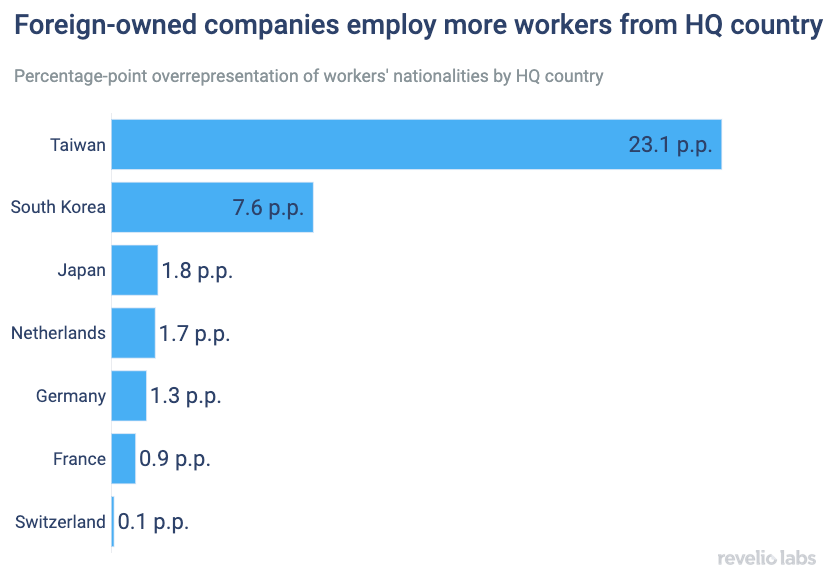
Using HR data for 26 large multinational companies in the automotive, health & pharmaceutical, and tech industries in the US, we find that foreign-owned companies prefer to employ workers from their country of origin, even in branches overseas. This is particularly true for Asian companies: For example, the share of Taiwanese employees in the US branches of Taiwanese companies is 23.1 percentage points higher than the share of Taiwanese employees in American companies.
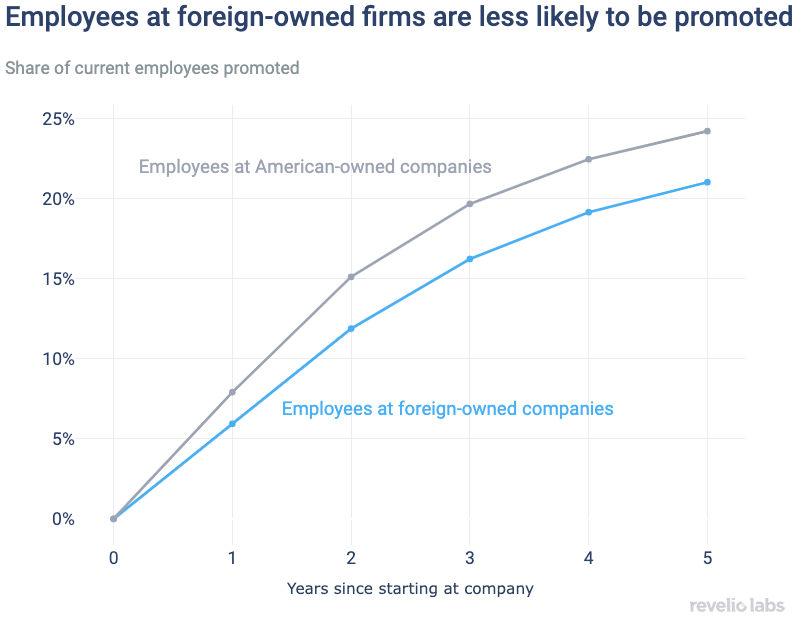
What are the career advancement prospects for US-based employees in foreign-owned companies? It seems that foreign companies tend to promote employees less often: Workers currently employed in foreign-owned companies received fewer, and later, promotions than workers currently employed in American-owned companies.
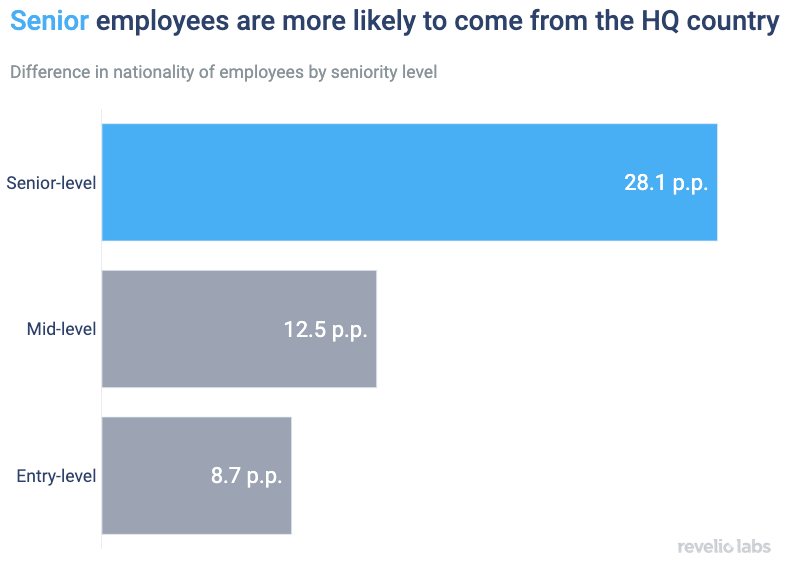
We also find that employees from a company’s country of origin are overrepresented in senior positions in the US branches, consistent with a top-down management style where decisions are primarily made in the headquarters office and senior management is transferred in from the headquarters overseas.
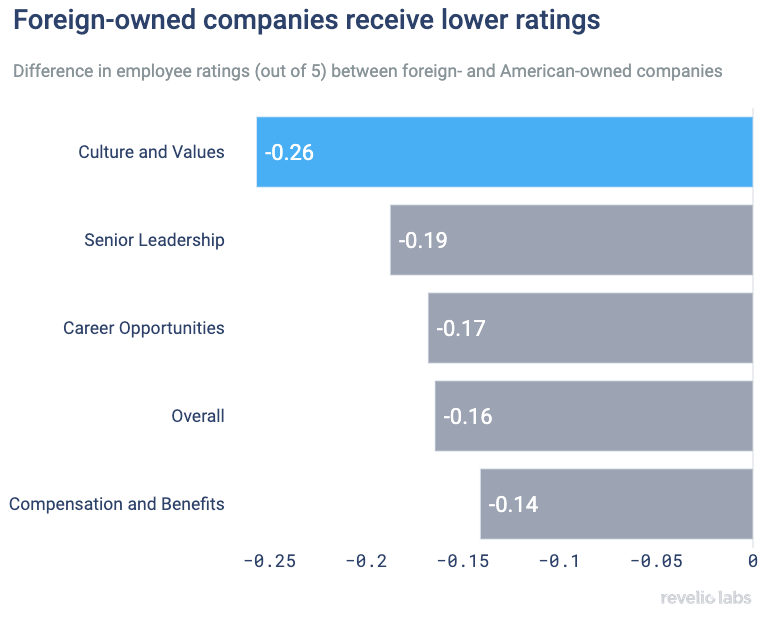
The top-down management approach in foreign companies is one of the biggest cultural differences from companies in the US. This approach affects employee sentiment in foreign companies negatively: Foreign companies received lower ratings across all categories relative to American-owned companies. Differences in the “Culture and Values” and “Senior Management” ratings between foreign- and American-owned companies are largest, suggesting frictions may occur between local entry- and mid-level employees and senior management from abroad.
A more in-depth examination of company reviews in Revelio Labs HR data also shows that these foreign headquarters are not well-perceived: Mentions of the headquarters country are mostly negative in employees’ reviews.
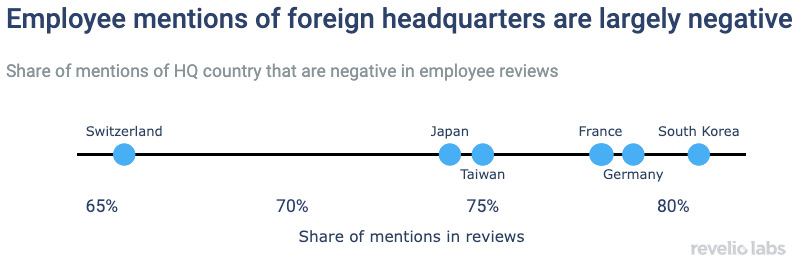
Changing these employees’ opinions of headquarters may call for greater communication and transparency from management, a willingness to adapt to local culture, and expansions in career development opportunities abroad. Nevertheless, multinational companies may benefit from improving their perception in branches overseas, which could result in increased employee satisfaction, retention, and productivity.
Free to reproduce with attribution and a link to reveliolabs.com.
Cite this article
- Plain text
- Revelio Labs, "Work Cultures Clash Between Foreign Bosses and US Employees," July 11, 2023.
- HTML
- Revelio Labs, "<a href="https://www.reveliolabs.com/news/business/work-cultures-clash-between-foreign-bosses-and-us-employees">Work Cultures Clash Between Foreign Bosses and US Employees</a>," July 11, 2023.
- Academic
- Hao, S. (2023, July 11). Work Cultures Clash Between Foreign Bosses and US Employees. Revelio Labs.


