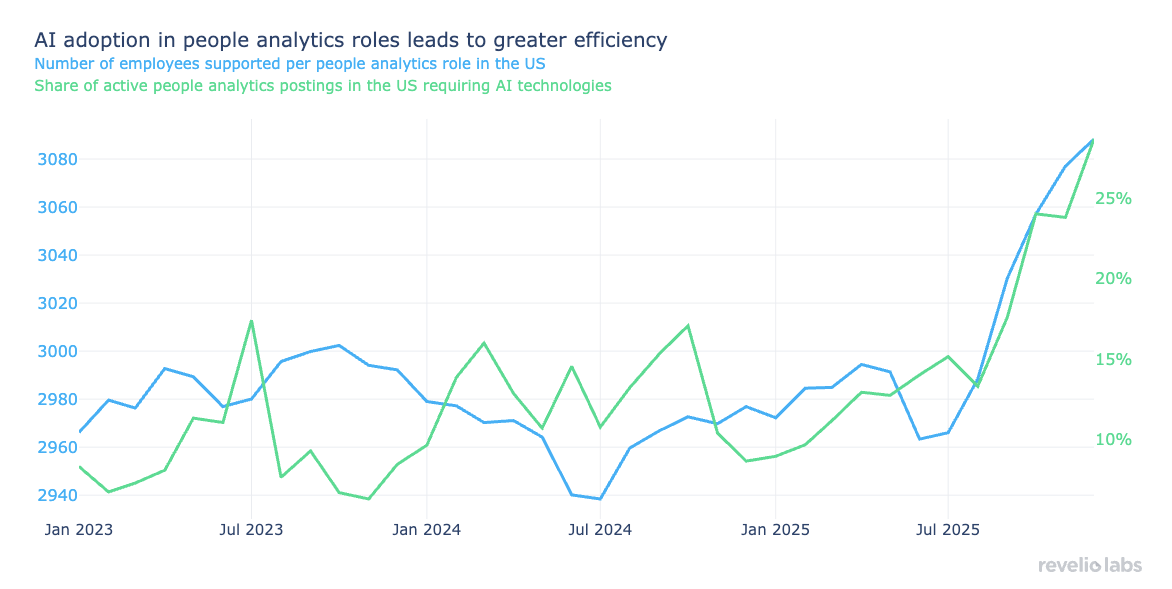
Dual-axis line chart from January 2023 to mid-2025 showing the number of employees supported per people analytics role in the US (left axis, around 2,940 to 3,080) alongside the share of active people analytics postings requiring AI technologies (right axis, roughly 6% to 28%). Both lines trend relatively flat through 2024 before rising sharply together starting mid-2025.
Outside of engineering, people analytics is the fastest to adopt AI
Figure 4.Dual-axis line chart from January 2023 to mid-2025 showing the number of employees supported per people analytics role in the US (left axis, around 2,940 to 3,080) alongside the share of active people analytics postings requiring AI technologies (right axis, roughly 6% to 28%). Both lines trend relatively flat through 2024 before rising sharply together starting mid-2025. Source: Revelio Labs, February 2026
title="Dual-axis line chart from January 2023 to mid-2025 showing the number of employees supported per people analytics role in the US (left axis, around 2,940 to 3,080) alongside the share of active people analytics postings requiring AI technologies (right axis, roughly 6% to 28%). Both lines trend relatively flat through 2024 before rising sharply together starting mid-2025."